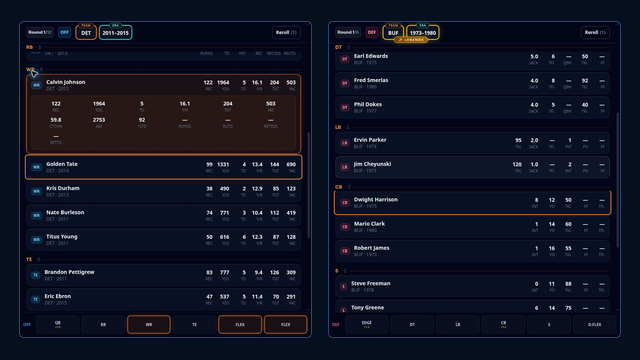
82-0 Game
NBA players. Five choices. Your draft.

82-0 Game.
Can you go 82-0?

Play the 82-0 game: spin an NBA franchise and an era, choose a player, and complete a five-man roster. Then find out whether its projected record reaches 82 wins without a loss.

Team + era spinsFive player picksOne undefeated target
82-0 · NBA draft challenge
82-0 game screen offering Classic and HoopIQ draft modes
NBA roster draft
Five picks.
Make them count.

Choose a mode inside the game.

Press Play to open the game.

First run? Start with Classic to see the numbers. Use Fullscreen when the player list needs more space. On a phone, keep your device upright.

Learn the draft →
Why the draft gets interesting

What is the 82-0 game?

A familiar name can start the debate. The card gives you something to compare.

Read the version in front of you.

The NBA 82-0 game is a roster-building challenge based on historical player statistics. A famous name is only the starting point: the draft evaluates the production of that player's particular franchise-and-era card. Read the version before committing the pick.

Think of LeBron James in Miami and in Los Angeles: the name is the same, but those are different parts of his career. In a draft built around teams and eras, that distinction matters before you even begin comparing numbers.

The choice gets interesting when the cards pull in different directions: one player scores more, another adds passing or rebounding. Decide what you are giving up when you choose. A shortlist is more useful than a plan that depends on the next spin delivering a particular star.

Check the draft rules →
The pool

Clear an old search or position filter if the player list seems unexpectedly short.

The slot

Check which roster slots are already filled before committing to the next selection.

The skip

A respin changes the offered pool; it does not let you request one named player.

The review

Record the mode alongside the score when you save an attempt for comparison.

Pick the help you need

Start here

Go straight to the controls, a draft decision, or the number you need explained.

Choose how you want to think

Classic or HoopIQ?

Would you rather compare the numbers or make the call from memory?

The stat line is visible

Classic

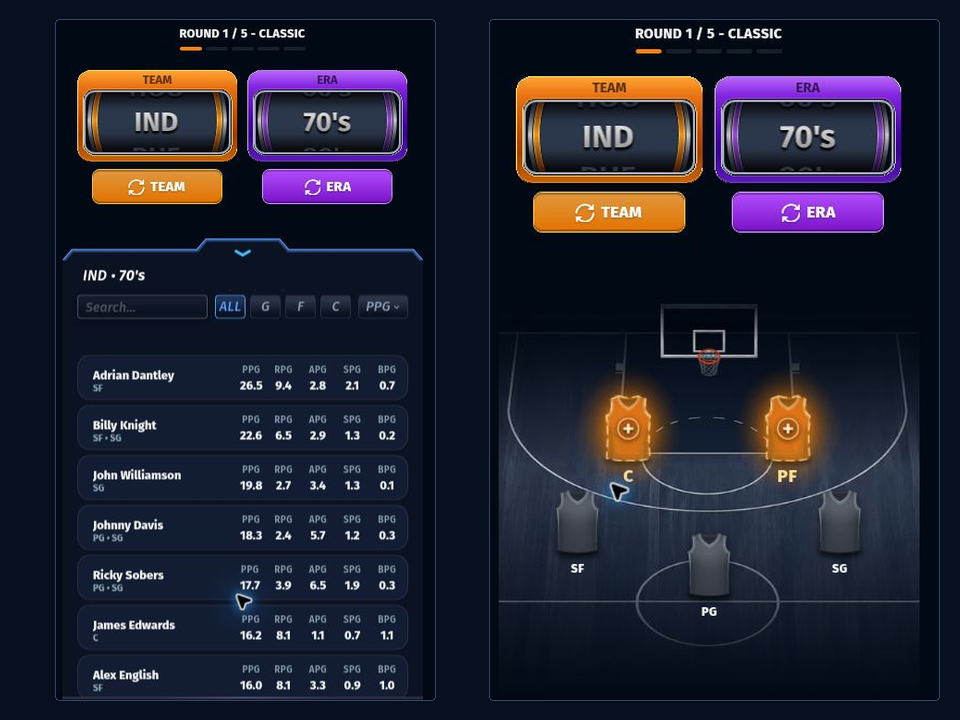
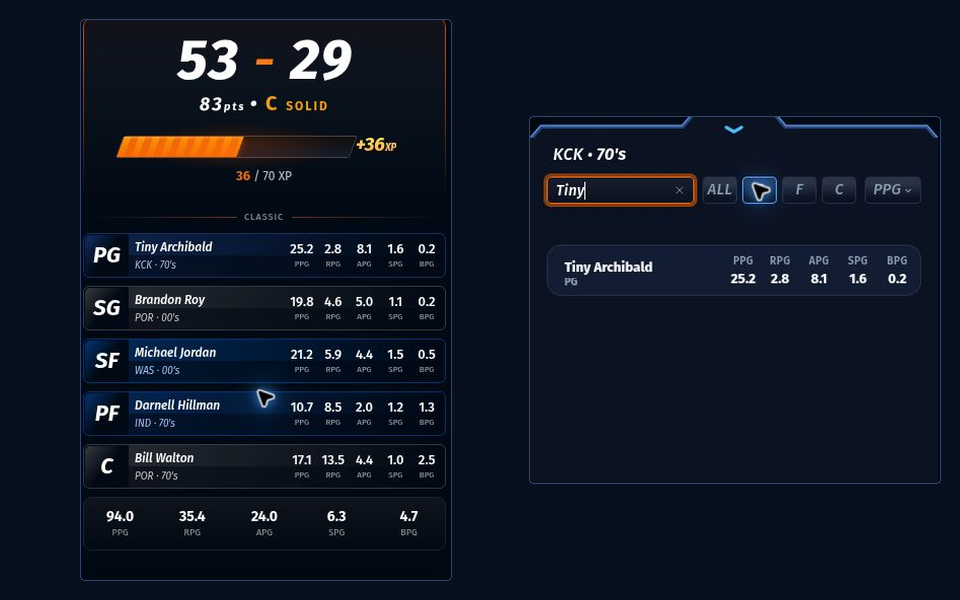
Classic shows the stats on each player card. Use search and position filters to narrow a long list, then check the selected sort category before taking the first name as the best choice.

A quick exercise: sort by PPG, then inspect the RPG and APG of the leading candidates. Use the sort to build a shortlist; the separate card columns show where those candidates differ.

Learn the Classic controls →
The stat line is hidden

HoopIQ

HoopIQ hides the card numbers while you make your selections. Think back to the drawn team's main scorer, rebounder, and passer. Those jobs may belong to different players, which is where knowing the squad helps more than recognizing one superstar.

Test your recall: name a second plausible option before committing. If you can only remember one star, pause and think about who else was doing the work on that team.

Get ready for a blind draft →
Two different ways to change a draw

Which part of the spin would you keep?

Classic draft board showing a team-and-era draw, player statistics, and roster slots in 82-0
Read TEAM and ERA separately.The counters show which basic respin remains available. Check them before planning to change a draw.

Respin the team

This keeps the era and changes the franchise. It suits a draw where you want to keep that period but have inspected this team's available list and found little worth selecting.

Before you press it, name the best card you are turning down. You are giving up that known option for a new team draw.

Review team-skip situations →

Respin the era

This keeps the franchise and changes the era. Consider it when the team's history offers several useful player pools, while its current draw leaves you choosing between weak options.

A franchise's one famous peak is a reason to be tempted, but the respin can land in another part of its history. Think about the other possible eras before spending it.

Review era-skip situations →
Know what each column counts

Read all five player stats

Use the same column when comparing two players; each abbreviation counts a different contribution.

What the card numbers mean, and what to compare
Card statA useful readingDetailed guide
PPG · PointsAverage points scored per game. PPG describes scoring volume; it does not tell you how efficiently those points were scored.Compare scoring →
RPG · ReboundsAverage rebounds per game, including offensive and defensive boards. Use the number on the card rather than guessing from height or position.Assess rebounding →
APG · AssistsAverage credited assists per game. APG counts passes credited with setting up a basket, so it is narrower than every useful pass a player makes.Assess playmaking →
SPG · StealsAverage steals per game. These are recorded takeaways; forcing a bad shot or denying a pass will not necessarily appear in this column.Interpret steals →
BPG · BlocksAverage blocked shots per game. Check BPG separately from SPG: a player who blocks shots is contributing a different recorded event from a player who gets steals.Interpret blocks →

These values belong to the selected franchise and era, rather than a player's whole career or one standout season. Some defensive values from older eras may be estimated where historical records are incomplete. Read how decade averages work to understand the period represented by a card.

A short comparison exercise

When one card gains points and loses elsewhere.

Suppose one option gives you 3 more PPG, but 2 fewer RPG and 2 fewer APG, with the same steals and blocks. You have found a trade-off, not an automatic upgrade.

Write down both sides of the exchange. You gain scoring and give up rebounding and assists. Treating the five raw columns as an equally weighted total would conceal that choice; it is not the published season calculation.

A cleaner case is a card that is no lower in any counted category and higher in at least one. There is no statistical sacrifice between those two options. Mixed comparisons need more thought, which is why the biggest PPG number cannot resolve every draft.

Practice comparing player cards →

The changes above are illustrative, not player data, card values, or hidden scoring weights.

Use the result without overreading it

What can you learn from a near miss?

81-1 tells you the outcome.
It doesn't tell you the fix.

An 81-1 finish is one projected loss across the schedule. Start your review with the five-player roster: which selection had the weakest case when you made it, and which alternative did you reject? The game turns combined statistical output into wins through a nonlinear projection, so one extra PPG is not a fixed fraction of a win.

Choose one decision to examine rather than blaming the whole draft. For example, if you selected a scorer without comparing the other columns, note the alternative's gains and losses. That gives your next attempt a specific habit to improve, even when its spins are different.

Review a close result →
73–9
WinsLosses

73 wins + 9 losses = 82 games. This record reader illustrates the notation; it does not predict an in-game result.

82-0 end-of-draft screen displaying the projected season record and selected lineup
Keep the lineup with the result.A record screenshot by itself gives you little to review. Include the player cards and mode so you can return to the actual draft rather than a remembered version of it.
Untangle the sports names

Football, hockey, soccer, or baseball?

The season length and the roster both change when you switch sports.

American football

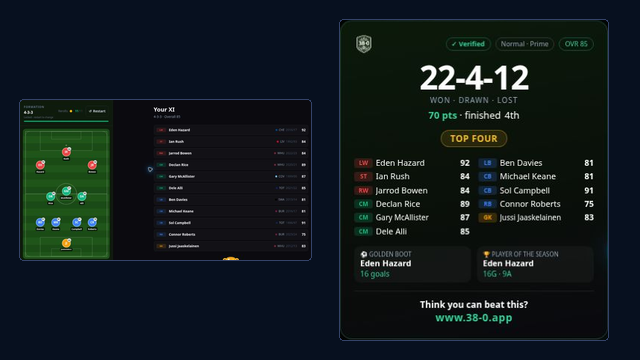
Looking for an 82-0 game for football? The NFL target in 20-0 is a 20-win run: 17 regular-season wins and three playoff wins. That is a different objective from an NBA regular-season record.

Understand the NFL target →

Hockey

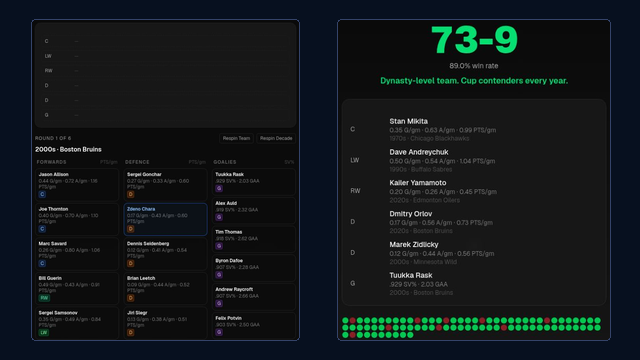
The NHL 82-0 game uses six slots: center, left wing, right wing, two defensemen, and goalie. You still chase 82 wins, but you have a separate goaltending role to fill.

See the hockey lineup →

Baseball

Diamond Draft aims at 162-0 with nine lineup positions, a starting pitcher, and a closer. The draft asks you to assign the player to an open slot as well as choose the name, so pitching has its own place in the build.

See the baseball roster →
Choose a different drafting problem

More Similar Games

Choose the kind of roster you want to build next.

Questions beyond the basic rules

Before you try another run

A few questions that come up once you have tried the draft.

Open the full FAQ →
Should I restart after an awkward first spin?

Inspect the pool first, especially if the team is unfamiliar. If you restart before reading any cards, you miss the chance to discover a useful player from that franchise. Restart when you want a fresh run; use the first-pick guide when you want to assess the opening draw.

Can I compare Classic and HoopIQ attempts fairly?

Keep each mode in its own comparison: Classic and HoopIQ give you different information while drafting. Note whether you used either respin, too. Different spins can offer very different choices, so compare the starting conditions before treating a higher finish as evidence of better decisions.

What is the 0-82 reverse challenge?

The aim flips: you try to build a roster that returns zero wins. Look for low production across all five counted categories; a weak scorer can still add rebounds or assists. Judge the attempt by the returned record, since a poor-looking lineup does not establish a winless result. The reverse-draft guide develops that approach.

Do I need to follow live NBA results to play?

No. Your record comes from the historical cards you draft, not from waiting for players to perform in upcoming fixtures. You can complete a roster and get its projection in the same session. Following basketball history helps with recognition, but you do not need to manage a live fantasy league.

Can I play the 82-0 game unblocked on any network?

No. A network can allow this guide to load while blocking the game inside it. The access guide explains that distinction. If you can see the game controls but they stop responding, follow the loading and control checks instead.