Recovery or deliberate tap
A defender directs a live miss to a teammate. The rebound can belong to the tapper, rather than automatically to the teammate who catches it.
A four-rebound lead looks attractive. In the 82-0 game, the useful next question is what the legal alternative gives up elsewhere—and what the combined RPG number cannot show.
Useful gain. Read the entire receipt.
Both fictional frontcourt entries below fit the same open jersey. Glass A leads in RPG and BPG; All-round B supplies more points, assists and steals. Calling A the better rebounder is easy. Choosing A still means accepting the rest of the exchange.
| Category | Glass A | All-round B | Change |
|---|---|---|---|
| PPG | 18 | 24 | −6 |
| RPG | 14 | 10 | +4 |
| APG | 2 | 5 | −3 |
| SPG | 0.7 | 1.2 | −0.5 |
| BPG | 2 | 1.3 | +0.7 |
An individual rebound follows a missed field goal or free throw while the ball is live: a player recovers it, or deliberately taps it to a teammate. The deliberate tap matters. You do not have to hold the ball yourself to receive the credit.
A defender directs a live miss to a teammate. The rebound can belong to the tapper, rather than automatically to the teammate who catches it.
A team rebound may account for a miss when play is stopped without an individual recovery. That bookkeeping credit is separate from the individual RPG you read on a card.
RPG divides an individual's credited rebounds by appearances in the represented sample. It counts recovery events; it does not tell you how many rebounding opportunities were available, how many teammates were boxing out, or what share of all misses the player secured.
These invented averages both total eight RPG. The rings separate offensive from defensive rebounds within each example. No real player data is implied, and the split is not an extra field supplied by the game's five-column card.
The offensive side creates another chance for the team that missed; the defensive side ends the opponent's attempt by securing the ball. The combined average cannot reveal the split. Do not silently assign the first mix to one candidate and the second to another because of a remembered reputation.
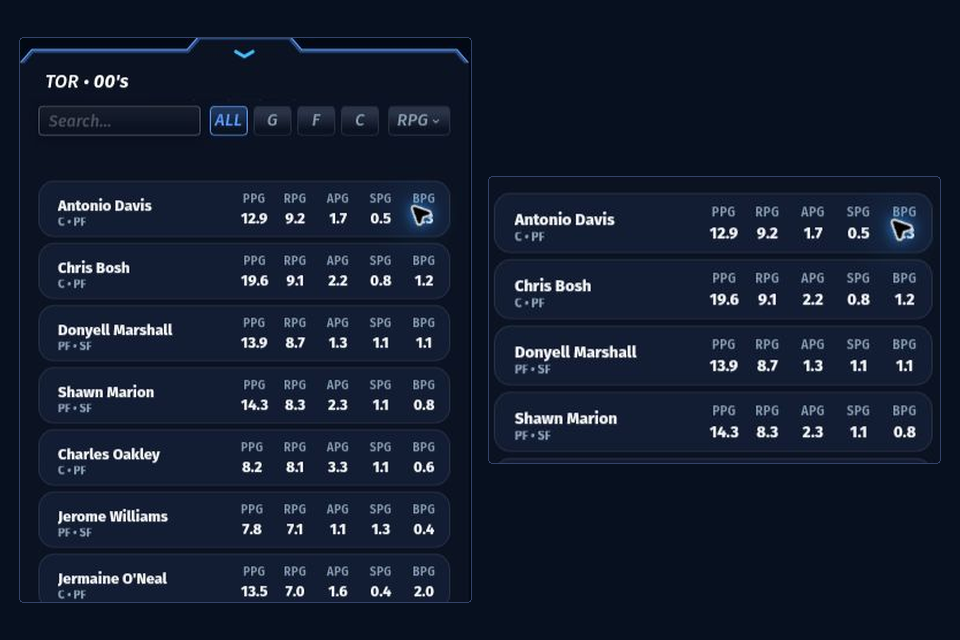
Read the RPG difference beside the other four fields. The card's franchise and era identify which entry you are comparing.
A legal forward or guard may supply rebounds that your center does not. Count the contribution where the card can actually go, rather than expecting the C slot to repair every rebound concern. The without-Wilt challenge works through that distribution across a complete practice roster.
For an unfamiliar candidate, use RPG to locate the rebounding contribution, then identify the price of choosing it. A visible lead is informative even when the projection weights are unknown. Keeping the gain and its cost separate makes the next choice easier to explain.
Compare the rebound gain with the full alternative before your next placement.
Play on the homepage →