Find the decision, then open its guide
What is on your board right now? An empty roster calls for an opening decision. A disappointing team-and-era offer calls for a respin comparison. Four placed players call for a last-slot check. Use that state to choose a guide below.
The stage map follows the five selections. The cards below it point to the full explanations; you can jump straight to the decision you need and return to the draft.
- 1Opening
Take or exchange? - 2–4Developing roster
What stays useful? - 5Last space
What can fit?
At the last stage, check legal roster moves as well as the empty jersey. A rearrangement may change which candidate you can place.
Choose the question you need answered
Is this opening worth keeping?
Evaluate a known candidate, the position it would occupy and the cost of exchanging an otherwise empty board's first draw.
Read the first-pick guide →Retain the eraWould another franchise help?
Work through three situations where the period is acceptable but the current team's usable pool gives you a reason to consider a team respin.
Open the team decision cases →Retain the franchiseIs another period worth the uncertainty?
Separate knowledge of a franchise's history from confidence that a new era draw will offer a player for the board you actually have.
Inspect the era switchboard →Four placements already madeWhat completes this roster?
Review compatible final candidates beside the four-player totals. Use an illustrative addition exercise without converting it into a win prediction.
Audit the last slot →An avoidable decision errorWhich habit needs repairing?
Match a symptom to an action you can change: an old filter, the wrong card context, a careless placement, a rushed skip or an unsupported result explanation.
Find the relevant repair →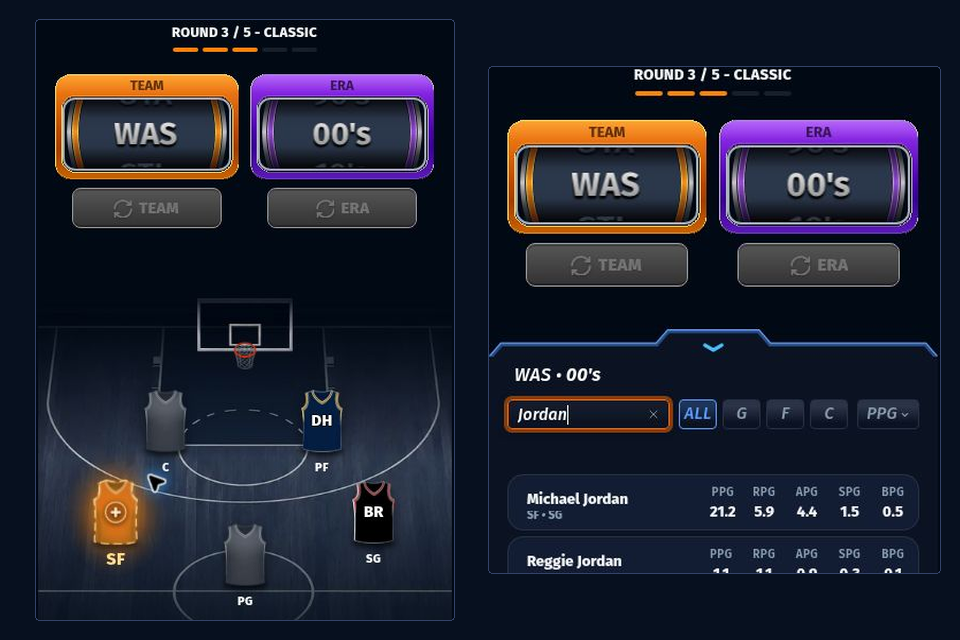
Match the symptom before changing the draft
| Observation | Next question | Useful destination |
|---|---|---|
| The board is empty and the roll looks unfamiliar. | Have you inspected its best usable option? | Opening decision |
| You like the period, but not this team's usable cards. | What known card would the TEAM action discard? | Franchise exchange |
| You know the franchise, but not this slice of its history. | Is the concern weak output or a gap in your memory? | Period exchange |
| Only one jersey remains unfilled. | Which candidates can actually enter that space? | Completion audit |
| The choices seem much narrower than expected. | Is the view filtered, or is the board genuinely restrictive? | Selection repairs |
Give one attempt a useful purpose
Can you go 82-0? Keep that target, but give the next run one smaller job: compare the best usable card before a respin, read the alternative columns in Classic, or notice a legal move you would normally miss. Pick the habit before starting.
An attempt in the 82-0 game gives you a record and a set of choices to review. Note the one habit you practiced alongside the lineup. That note tells you what to try next even when the result is a close miss.
When strategy is not the missing piece
If you cannot tell whether a placement completed, use the walkthrough. If you are unsure what a control is allowed to change, use the rules. If visible numbers make the list harder to read, Classic's control exercise is a better starting point than a new respin rule.
If the numbers are hidden, open HoopIQ for the recall drill. If you keep making the same avoidable error, open Common Mistakes and choose its matching repair. Each route gives you a smaller task than rebuilding your whole approach after every loss.