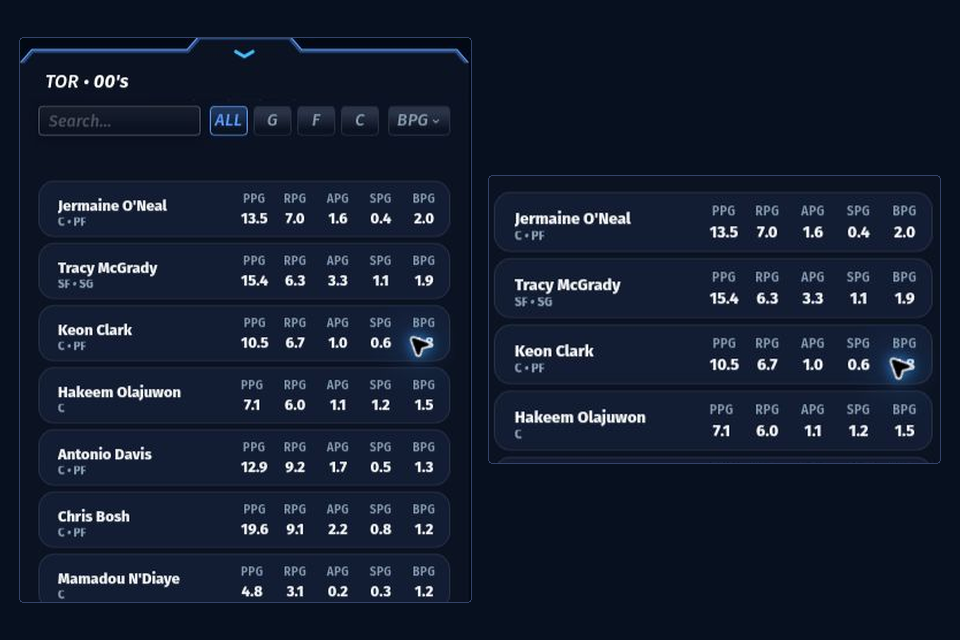
Before comparing a BPG lead in the 82-0 game, inspect what kind of value you have. Then separate the blocked attempt from the recovery that may follow it.
📁 Defensive data file
Inspect the value before interpreting it
A block average can be printed as a number, absent from an entry, or based on estimated historical data. These are different data states. The inspection sheet below describes how to read them; it does not invent badges or labels on the game's interface.
Reading conventions, not three actual player cards
What you encounter
What it establishes
What to avoid
A displayed number
A supplied BPG value at the shown precision
Calling it a measurement of all shot deterrence
0 or 0.0
The numeric value shown for the entry
Assuming a rounded zero proves no blocks anywhere in the sample
A dash
No numeric value is presented in that field
Replacing it with a guessed zero
Historical estimate
A reconstructed contribution rather than an original complete record
Inventing its method, uncertainty range or exact adjustment
🗂️
The game's rules describe estimation for missing older defensive statistics. The reconstruction method is not established here. A displayed BPG number alone does not tell you whether it came from a complete measured record or an estimate.
✋A block changes a field-goal attempt
A credited blocked shot involves a defender touching a field-goal attempt so that it does not score. The category includes a blocked perimeter attempt; it is not limited to a center swatting a layup at the rim.
BPG divides those credited blocks by appearances in the represented sample. A shooter deciding against an attempt because a defender is nearby is a different event. There is no blocked attempt to credit merely because the defender discouraged the shot.
AttemptThe opponent shoots a field goal.
BlockThe defender alters it and it misses.
Live ballThe ball may remain available.
RecoveryA team secures it, or play stops.
The last stage is why a block should not be described as an automatic possession win. The offense can recover the live ball after the block. A rebound, when credited, is its own event with its own recipient; BPG does not silently include that credit.
Two cards, two kinds of confidence
Suppose two legal alternatives display 2.1 and 1.8 BPG. You can describe a printed lead of 0.3. You cannot calculate a historical error margin from those digits, or adjust an older entry down by an arbitrary percentage because you know some older data required estimation.
If a field is a dash, the comparison has a missing input. Say so in the choice note. Treating the dash as zero would make the arithmetic look complete while changing what the card actually told you.
The comparison laboratory handles numerical exchanges when the fields are present. The averages workbench handles context and precision. Neither supplies the missing historical reconstruction recipe.
Inspect the offered field
Use the supplied value and its printed precision. Do not add an imagined reliability badge to the card.
🔖Finish with a precise description
“This entry has the higher displayed BPG” is a narrower, better-supported statement than “this player stops more possessions.” It states the advantage without adding unseen deterrence, recovery or historical certainty.
In the 82-0 game, that distinction keeps the defensive comparison usable. Record the advantage, identify any missing field, and keep a mixed-category choice separate from a claim about the eventual record. The rebound guide follows the recovery event after a miss if that is the part you want to understand next.
Inspect both the block value and the card context before selecting the specialist.