- Seven two-point baskets: 14
- One three-point basket: 3
- Three made free throws: 3
Eight field goals made from twenty attempts.
Two players can score the same twenty points in very different ways. This 82-0 game guide starts with that puzzle, then follows the information PPG keeps and the detail it drops.
Start with a scoring puzzle. These two fictional performances both finish with twenty points, but they reach the total through different baskets and free throws. The breakdown is useful because PPG on a draft card keeps the points and leaves this detail behind.
Eight field goals made from twenty attempts.
Six field goals made from twelve attempts.
PPG averages points over appearances in the represented sample. Two-point field goals, three-point field goals and successful free throws supply those points. A scoring average does not contain the attempt counts needed to calculate field-goal percentage.
In the opening example, A's field-goal percentage is 8 ÷ 20, or 40%; B's is 6 ÷ 12, or 50%. Those figures can be calculated because the exercise supplied attempts. If all you knew was “twenty points,” neither percentage would be recoverable.
The 82-0 game gives you a compact scoring input. Use that input as shown. Do not award the card an imagined efficiency adjustment, or deduct points because you remember a style of play you would not want on a real team.
Now leave the shooting puzzle and compare two legal practice cards. Both are assumed to fit the same remaining position. Scorer X supplies six extra PPG; Option Y supplies more in every other listed category.
| Category | X | Y | Exchange for X |
|---|---|---|---|
| PPG | 32 | 26 | +6 |
| RPG | 5 | 8 | −3 |
| APG | 3 | 7 | −4 |
| SPG | 1 | 1.7 | −0.7 |
| BPG | 0.4 | 0.8 | −0.4 |
“X scores more” is correct. “X wins the comparison” needs another reason. The scoring increase arrives with four category losses, and its six-point size cannot be subtracted from a block or steal difference to form a universal value.
Use the comparison laboratory for that classification. This page's job is to expose how the PPG lead catches your eye before the price of the choice does.
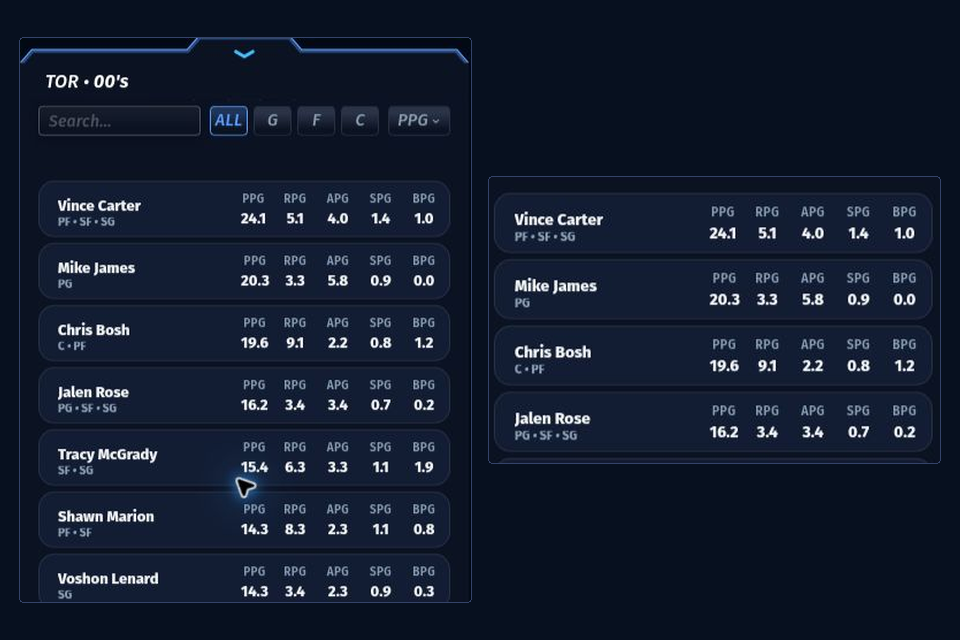
A PPG sort is helpful when the pool is unfamiliar: it locates scoring production quickly. Stop at the top legal entry long enough to read its other fields, then compare one plausible alternative. The sorted order is a view of one column, not a five-category verdict.
The Classic controls explain how to make that view. If the lead belongs to a card you cannot place, checking the offered positions comes before treating it as a missed scoring upgrade.
In a hidden-stat draft, your scoring expectation remains a memory judgment. Make it specific to the offered context; do not attach the invented performance numbers from this page to any actual player.
Use PPG to find a shortlist, then choose after reading across each legal card.
Play on the homepage →