What disappears, and what remains
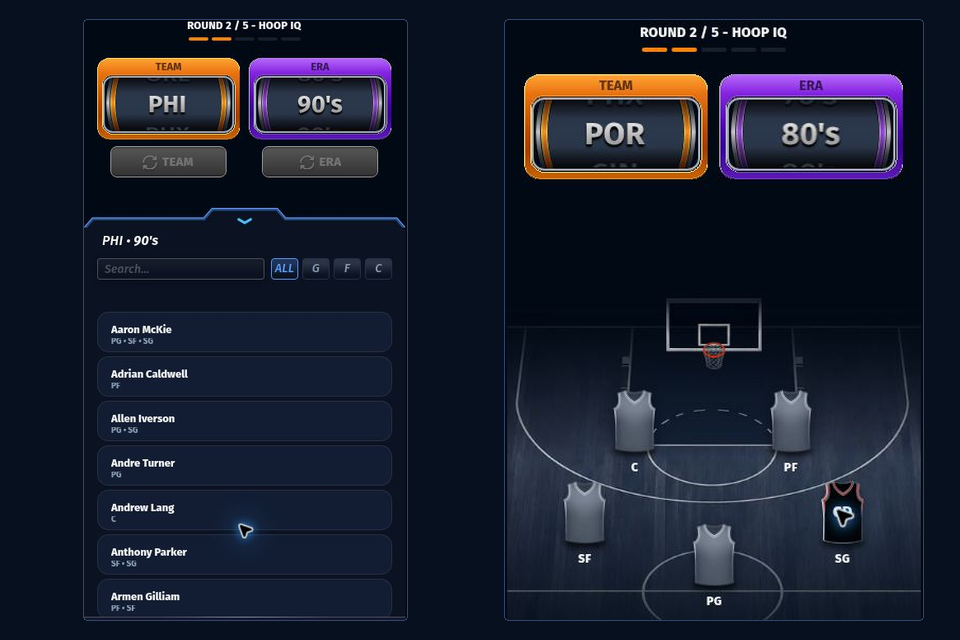
HoopIQ removes the visible stat values during the 82-0 game draft and disables statistical sorting. You still see the franchise, era, candidate names and roster positions. The useful question is what you remember about each offered version while those numbers are hidden.
A famous name can be the right choice for the wrong reason. Ask what the player contributed on this team in this period. If your strongest memory comes from another stop in the career, pause and look for a second candidate you can place.
Build a memory cue with three layers
The team role
Was this player the primary creator, the main scorer, a rebounder, or a smaller supporting piece on the drawn franchise? Use the role to form an expectation. A later starring role elsewhere may be the memory you need to set aside.
The period
Separate an early contribution from a peak or a later phase. You do not need to recite every season. You do need a reason that connects your remembered player to the offered time window.
The place left to fill
Check which positions the card can occupy now. A useful memory cue combines expected production with a possible placement. The last remaining jersey can make a broad favorite irrelevant.
Use the three cues together. Remembering an excellent passer is useful only if that memory belongs to the offered entry and the card can enter your roster. If one cue is missing, keep the uncertainty in view while comparing another candidate.
A recall drill before you tap
Write a reason, not a ranking
Choose one offered candidate and finish this sentence: “For this franchise in this period, I expect this player to contribute mainly through…” A role-based reason is easier to test later than calling the player an all-time great.
Now identify one detail you are unsure about. Perhaps you remember the scorer but not the rebounding, or the franchise but not the length of the stay. That uncertainty tells you where a second candidate deserves consideration.
Challenge your first memory
Look for a different kind of contribution in the same pool. If your first choice is a scorer, ask whether you recall a creator or a frontcourt producer who also fits. You are checking an alternative, not promising that the less famous player is better.
Finish with one sentence: “I prefer this card because…” If you cannot finish it beyond the player’s reputation, return to the drawn team and period. Once you have a reason and a legal destination, make the pick.
Check the depth of your recall
Mark the cues you can recall for the current offer. Use an unchecked box as a prompt to examine another candidate or reconsider the player version you remember.
The bar counts marked statements. It is a self-check, not a card rating.
Turn one surprise into useful study
After the result, choose one selection you struggled to judge. Read any full card details the game makes available. For more practice, use Classic’s visible columns when you encounter that franchise-and-era entry again. Keep the original context in your note so you know which expectation you are testing.
A small note is easier to test than a celebrity list. Keep the context, the expectation and the uncertainty separate, as in this illustrative notebook entry.
| Field | What you record | Purpose |
|---|---|---|
| Context | The team and ERA displayed for the card. | Study the offered version rather than a different career phase. |
| Expectation | “I expect passing to be this candidate's useful contribution.” | Give yourself a specific claim to verify. |
| Uncertainty | “I do not remember the rebounding in this context.” | Keep the gap in your recall visible. |
| Verification | Inspect the relevant columns when that version is available in Classic. | Check the original expectation before changing the story. |
For the next memory run, study the missing detail rather than rewriting the whole choice. If the note says you could not recall rebounding, check rebounding when the matching card becomes available. One useful correction is easier to retain than a catalogue of every player you might someday roll.
Two awkward situations
I remember only one name in the pool. Should I use a skip?
First inspect that card's offered positions and consider whether the franchise cues bring another candidate to mind. If you still cannot judge the pool, a respin remains an exchange for another uncertain draw. Check its allowance and use the era decision guide when the franchise is familiar but the period is not.
Should I look up the hidden numbers during a run?
Decide what challenge you want to play. If you want a memory attempt, outside notes change that condition. If you want to learn the interface and the figures, Classic gives you the information directly. Label your own comparisons honestly so a study session and a blind attempt do not become the same result category.