A useful comparison in the 82-0 game tells you what improves, what stays equal and what you give up. Try the practice pairs, then bring the pattern back to your actual board.
🔬
Start with the numbers
Find out whether there is a sacrifice
Pick a pair below. These invented cards have identical assumed eligibility, and their listed values are exact within the exercise. You can compare their five contributions without choosing a secret weighting formula.
Illustrative per-game values; no real player is represented
Card
PPG
RPG
APG
SPG
BPG
A
24
7
6
1.6
0.9
B
22
7
5
1.4
0.9
C
28
5
4
1.2
1.3
PPG+2RPG0APG+1SPG+0.2BPG0
Every difference keeps its own unit. A negative result is a contribution you give up by choosing the first card; zero is a tie in this exercise.
A ≥ B
No category sacrifice in the example
A has more points, assists and steals than B, with the same rebounds and blocks. B does not compensate for those losses with a lead elsewhere. If you need either card for the same slot, that is a much cleaner statistical comparison than “this player feels better.”
This pattern is called dominance: one option is at least as high in every compared field and higher in at least one. Here it applies to exact practice numbers. On a real card, the same reading establishes dominance of the displayed line, at the precision shown.
A ↔ C
A real exchange needs a reason
C adds four points and 0.4 blocks over A. A adds two rebounds, two assists and 0.4 steals over C. Both have a case, and the table cannot erase the conflict by counting how many columns each wins.
“Three wins two” is not a category weighting rule. Neither is adding +2 RPG to +0.4 SPG as though they shared a unit. State which contribution you are accepting and which you are surrendering; that is already a useful decision.
🚪Run the placement test before the verdict
Both fit the same usable slot.
You can compare them as replacements while leaving the other placements alone. This is the situation isolated by the laboratory.
Only one fits the present gap.
The other needs a permitted board move before it becomes an alternative. Check that move; do not count an unusable card as a sacrifice you chose to avoid.
Each requires a different arrangement.
Compare the two complete placement plans. A gain in the candidate's numbers may come with a loss of room for the next pick. The comparison now includes a board decision as well as the stat line.
The final-pick audit explains how an existing jersey can sometimes free a different slot. The laboratory assumes eligibility only to make the numerical pattern easier to see.
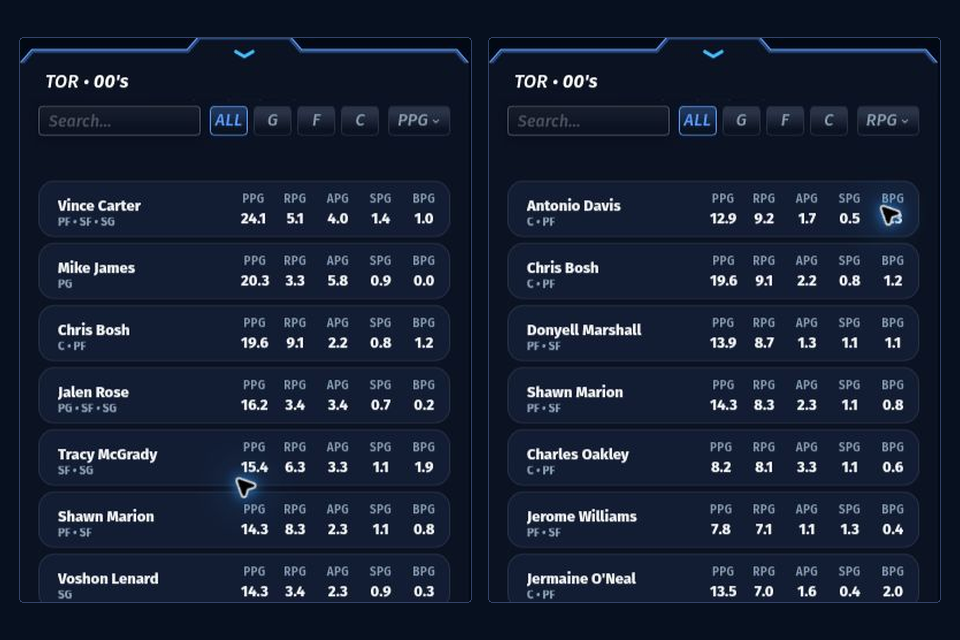
Compare the dealt entries, including positions and context. The exercise's A, B and C values are not assigned to the players in this screenshot.
🔎A printed tie is not a hidden decimal
Suppose both cards display 1.2 in a decimal field. Your observation is a tie at that precision. Do not break it by inventing another digit or claiming one player's reputation proves a higher underlying value.
The game's team summary sums supplied values before formatting them. When those supplied values carry extra precision, adding the printed fields can differ from the formatted team total. A “no lower displayed value” comparison is a sound description of what you saw; an exact claim about every hidden input goes further. See the rounding example for the arithmetic.
Card identity matters too. A remembered career line and a current team-and-era entry are not interchangeable observations. Compare what is offered now, rather than building one player's case from a peak and the other's from a broader average.
✍️Keep the rejected alternative in your note
“A over C: keeping the rebound and assist contributions, accepting fewer points and blocks.”
That note tells you what happened even after the result arrives. “A was better” loses the comparison. You can review the actual choice without assigning a made-up number of wins to each difference.
Classic in the 82-0 game supplies the visible fields needed for this test. Hidden values in HoopIQ require a different kind of judgment: a remembered profile, with uncertainty attached. For the later conversion to wins, use the projection reader; this lab deliberately stops at comparing contributions.
Use the comparison pattern on two real legal alternatives from your next draw.