Card Averages: Context, Weight and Precision
A remembered peak, a career average and a dealt entry can describe different samples. This 82-0 game workbench shows how context, sample size and display rounding change the reading.
How much does each block count?
Block A averages twenty points; Block B averages thirty. Taking their midpoint gives twenty-five. Pooling all appearances can give a different answer, because a block with more appearances contributes more observations.
| Block | PPG | Appearances | Points |
|---|---|---|---|
| A | 20 | 20 | 400 |
| B | 30 | 80 | 2,400 |
Block B has more appearances, so the pooled average is above 25 and closer to its 30 PPG.
Why your handwritten sum can differ
There is another averaging trap after the number reaches the screen. The game can sum supplied numeric contributions before formatting the team total, while player fields are formatted individually. If supplied values carry more precision than the printed fields, adding the printed fields can produce a different last decimal.
Format the sum to one decimal: 2.5.
Add the already rounded fields: 2.4.
The values here are invented to isolate the effect. This is not evidence that every real card has hidden hundredths. It explains a possible discrepancy when extra precision is supplied; it does not justify replacing the displayed total with a guess.
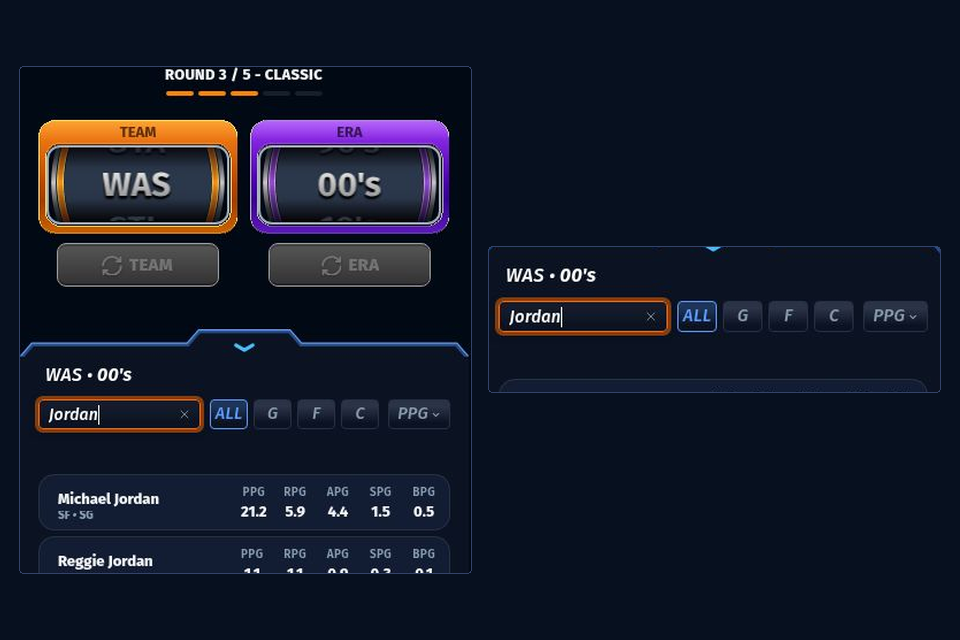
Career, peak and offered entry
- Career average
- Combines the appearances included in a career sample, potentially spanning franchises and periods.
- Peak-season memory
- Describes one selected season, often the unusually strong one you remember first.
- Offered franchise-era entry
- Refers to the context shown on this card. It need not match either number above.
An unexpected card average is a reason to inspect that identity. It is not enough, by itself, to call the entry wrong. The era decision guide explains what a context change preserves and replaces.
Keep two kinds of uncertainty apart
A display-rounding difference concerns precision. An older defensive estimate concerns the source of the supplied value. They can both limit interpretation, but they are not the same issue. The historical data inspection deals with provenance and missing fields.
For the 82-0 game, use the dealt contribution and keep the context in your notes. If a manual total differs slightly, check formatting before diagnosing a bad result. If you are comparing printed ties, describe them at printed precision; the card lab shows how to make that claim carefully.
Keep the name, franchise, period and displayed line together in your draft notes.
Play on the homepage →