Do you want a different period, or a different team?
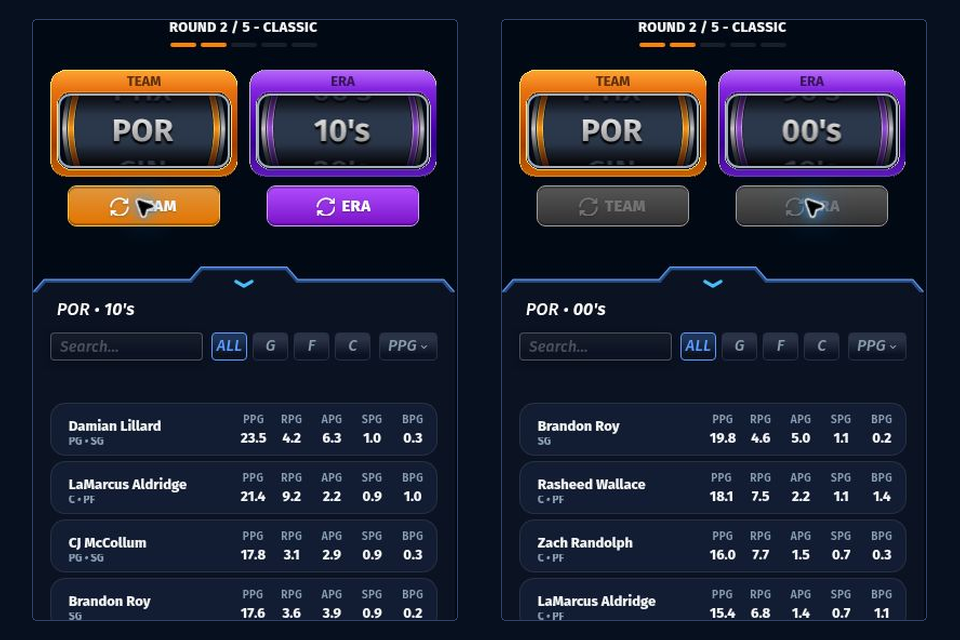
In the 82-0 game, ERA changes the historical window attached to the rolled franchise. The franchise stays in place. That makes the action useful to consider when you have a reason to retain the team but are unconvinced by the candidates offered for this slice of its history.
A favorite player may explain which period you hope to see. It does not choose that period for you. Before spending ERA, inspect whether the current window already offers a card that helps the roster; passing it up is the concrete cost of chasing that memory.
If you want to leave the franchise instead, the TEAM guide is the appropriate route. Naming the part you intend to preserve prevents an expensive press on the wrong control.
A franchise-history switchboard
Locate the memory you are using
Describe the franchise you know: its remembered main creator, frontcourt producer or scoring group. Then ask whether that memory belongs to the drawn window. A vivid memory from elsewhere in the franchise's history can make an ordinary current offer look wrong.
Inspect the period actually offered
Check the candidates, their compatibility with your open board and the information your mode provides. Classic can reveal a usable contributor you did not remember. In HoopIQ, uncertainty about names is a memory limitation, not a measurement of the pool's output.
Decide whether retaining the team has a basis
You should be able to say more than “this team had a famous peak.” Think about why another eligible period might produce choices worth exploring for the position you need. That remains a hypothesis until you inspect a replacement draw.
Follow the track with the franchise and era currently displayed. Write down the present usable option before replacing the window.
Three reasons, with different evidence
| Your reason | Evidence already available | What remains uncertain |
|---|---|---|
| “The usable cards in this window do not offer what I need.” | The open positions and the candidates you inspected. | Whether another period offers a better usable card. |
| “I remember this franchise much better in another period.” | The scope of your own basketball recall. | Whether greater familiarity means higher output. |
| “I want a specific star's version.” | A historical association you may be able to verify. | Whether the next roll reaches that window or even offers that card. |
The first reason can be assessed directly in Classic. The second can explain a preference in HoopIQ. The third describes a desired result of the respin, rather than evidence that the respin will deliver it. Keep those categories distinct when reviewing an attempt.
When the same team produces a different question
A familiar franchise, an overlooked contributor
You were expecting its celebrated scorer, but the current period offers a less familiar creator who fits an open guard slot. Read that card before dismissing the draw. If it makes a good contribution, an ERA action could replace a workable selection with another unknown period.
A late roster with a specific gap
Four positions are filled and the remaining space narrows your legal choices. Another era may introduce different candidates for that slot, but several famous names from the franchise's history can still be irrelevant to it. Evaluate the present fallback and read the final-pick audit before assuming history will solve compatibility.
A memory attempt you cannot explain
You recognize the franchise but cannot connect its offered names to any role. You may choose to spend ERA to seek a window you can judge better. Label the reason as better familiarity, not a proven statistical advantage. The HoopIQ recall exercise is useful practice for the uncertainty you encountered.
Use the control's actual allowance
Inspect the ERA remaining-use display and any stated condition. TEAM and ERA are tracked separately, and the game can expose session-specific availability. The existence of another control does not replenish the action you want to use.
After the action, read the replacement era and confirm the franchise stayed. The new draw resets search, role filter and sort. Inspect the new cards and their legal placement routes before applying a narrower view. The same jersey arrangement may suit one period’s pool better than another.
Review the window change without hindsight
A useful ERA note has four entries: franchise, old period, discarded candidate and new usable candidate. Put the two offers beside each other after the draw. That comparison shows what changed without turning a lucky replacement into a rule to chase the same period every time.
On the next attempt, check whether the same concern is present before pressing ERA again. Use Common Mistakes if you repeatedly confuse a memory gap with weak cards, or return to the strategy map when your board poses a different decision.