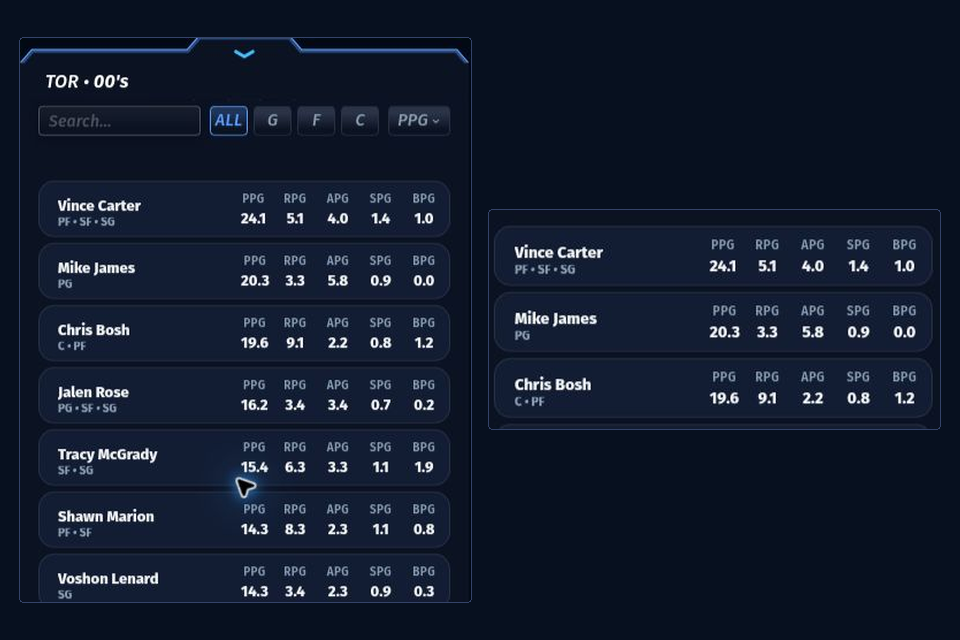
The NBA 82-0 game puts five averages on a Classic card. Start with the label you need, then use the glossary to separate its meaning from the size of the number.
Five labels, five different contributions
🎯
PPG · Points per game
The scoring average for the represented entry. Points from field goals and free throws feed the same scoring total. A large PPG figure tells you about volume; the card does not let you infer the shooting efficiency behind it.
The individual rebounding average. It combines offensive and defensive contributions without giving their split. A stopped-play team rebound is a different kind of credit.
A box-score total, a per-game card average and a roster subtotal are different quantities. The label matters as much as the digits. A stat discussion gets muddled quickly if one person means career events and another means the five draft entries.
Illustrative quantities; values are invented for this glossary
Quantity
Example
What it means
Individual event total
100 points
Points accumulated across the example sample
Per-game average
100 ÷ 5 = 20 PPG
The total divided by five appearances
Two-card subtotal
20 + 24 = 44 PPG
Addition of two practice contributions in one category
Returned season record
Wins–losses
The game's output after the roster is completed
The two-card subtotal is not a newly calculated player average, a complete five-player roster, or proof that a real pair would score forty-four together. It is exactly what its label says: addition of two supplied contributions. The result screen's wins and losses belong to a separate calculation.
🎴Locate the line
Name, franchise and period identify the entry. The five abbreviations describe its contributions.
Read the labels on a real Classic card. In HoopIQ the values are hidden during the choice; the abbreviations still describe the categories being considered.
🧭Choose the next page by the problem
The offered average looks unfamiliar
A remembered peak, career number or other franchise may describe a different sample. Use the averages workbench for context, weighting and rounding.
Two lines have different advantages
Classify the comparison before picking a winner. The card laboratory distinguishes displayed dominance from a real exchange.
You want to understand the final record
The projection reader separates the visible contribution summary from the game's conversion into wins.
You cannot see the numbers
The HoopIQ workshop deals with memory and uncertainty. A hidden line cannot support the same numerical test as Classic.
Take one unfamiliar card into the next draft and read every label before choosing.