Completed win share: 98.8% after rounding.
Challenges · Near-miss review
The 82-0 Game After an 81-1 or 80-2 Finish
You were one or two losses short. Before another draft, inspect the decision that deserves a closer look: its legal alternatives, the exchange you accepted and the lineup you actually finished.
How close were 81–1 and 80–2?
Completed win share: 97.6% after rounding.
Both finishes are close in the score notation: one or two losses remain. The bars divide completed wins by eighty-two; they say nothing about the odds of your next attempt. An 81–1 roster is worth examining, but the readout supplies no numerical distance from an 82–0 threshold.
Save the decision behind the close result
Before replaying, capture the actual finish and its five cards. Then pick the decision that felt hardest: the slot, the offered alternatives and the stat exchange you accepted. That is a useful starting point for a review.
The final pick is memorable because it comes last. Check whether it was genuinely the unresolved choice. An earlier placement may have spent a flexible slot or left the final offer with fewer legal destinations. Follow the last-pick walkthrough when placement options are the question.
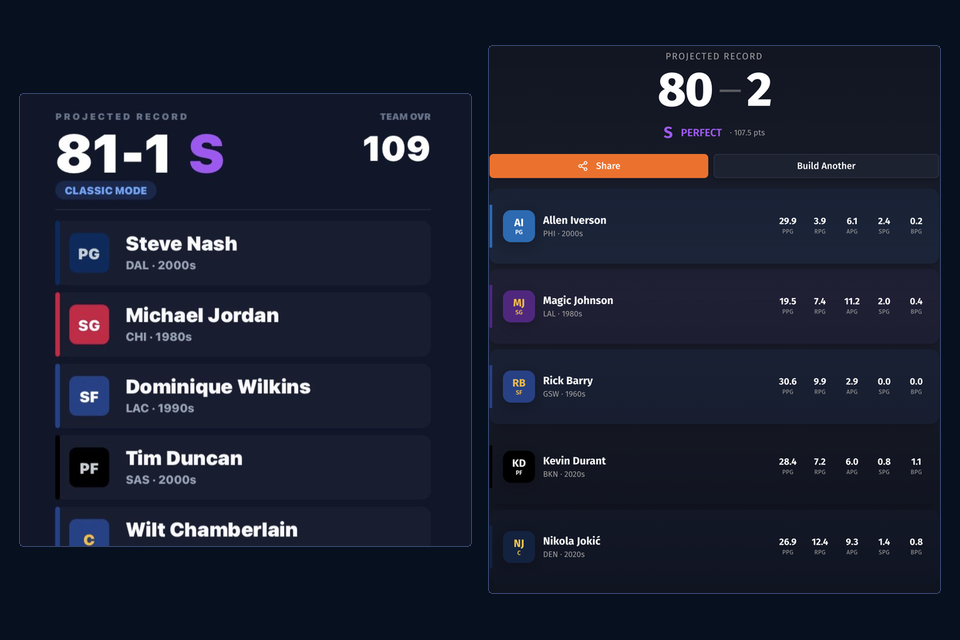
“More assists” is only half a comparison
Imagine that your rejected legal alternative offered more APG but less RPG. A useful note includes both changes and the slot you would use. The selected card's rebound contribution remains part of the exchange, even when the missing win tempts you to focus on assists.
A note you cannot test
“The team needed one more assist.”
This names a category but leaves out the candidate, its cost and its available destination.
A note worth revisiting
“At this open slot, the alternative raised APG and reduced RPG; both candidates were eligible.”
This identifies a real kind of decision. Add the actual card versions and printed differences from your offer.
The card comparison guide handles mixed rows. Use it to make the exchange explicit, then keep your interpretation separate from the returned season total.
The extra win belongs in the record
| Measure | 80–2 | 81–1 | Difference |
|---|---|---|---|
| Wins | 80 | 81 | +1 |
| Losses | 2 | 1 | −1 |
| Total games | 82 | 82 | 0 |
The one-win difference can be measured directly. A price in PPG, RPG or APG cannot be read from this table. Keep the completed record as the outcome and the card exchange as the decision you are investigating.
Carry one question into the next draft
- Choose the question.Example: did you spend a flexible position earlier than necessary?
- Inspect the new opportunity.Compare the new pool and destinations; the previous rejected card may not be offered again.
- Retain both outcomes.Different draws and rosters can change together, so record the new attempt even if it finishes lower.
A single close finish does not isolate a cause. Several well-described attempts can still improve how you choose: which slots you reserve, which statistical exchanges you notice and which draws you decide to keep.
Start the next attempt with one decision to examine, and retain its actual draw and returned record.
Play on the homepage →