The 0-82 Challenge: Build a Legal Low-Output Roster
Try the reverse target with a method you can explain: visible numbers, legal placements and a completed record. A weak-looking lineup is the starting hypothesis; the season return is the test.
Is it possible to go 0-82 in the 82-0 game?
A finished 0–82 would meet the winless challenge: zero wins across all eighty-two games. A verified example and an authoritative rule establishing whether that endpoint is reachable are not available here. Treat it as an experiment, with the returned record deciding whether your attempt succeeds.
Give the reverse draft a clear method
- Start in Classic.
Visible PPG, RPG, APG, SPG and BPG let you explain why one available card looks weaker. Read the whole row before choosing: the lowest scorer can still contribute more elsewhere.
- Compare cards that can fill the same job.
Check the offered positions and the board's usable destinations first. Compare two legal candidates for that opening. An unusable low-stat card gives you no completed selection to test.
- Decide what counts as your challenge.
Write whether special actions are allowed before the first pick. Keep that rule through the attempt. Changing it halfway through makes a later comparison harder to interpret.
When the weaker choice is easy to explain
| Printed field | Slate | Quartz | Slate minus Quartz |
|---|---|---|---|
| PPG | 8.0 | 9.5 | −1.5 |
| RPG | 3.0 | 4.1 | −1.1 |
| APG | 2.0 | 2.8 | −0.8 |
| SPG | 0.6 | 0.9 | −0.3 |
| BPG | 0.2 | 0.4 | −0.2 |
Slate is lower in all five fields. You can justify that choice without deciding how the simulator weights a mixed exchange. The last column records five differences; adding them would mix unlike categories and manufacture a score the game has not supplied.
A split row takes more judgment. For example, less scoring with more rebounding is a tradeoff, so describe both changes. Use Classic's viewing controls to inspect the candidates you actually received rather than replacing them with a remembered career peak.
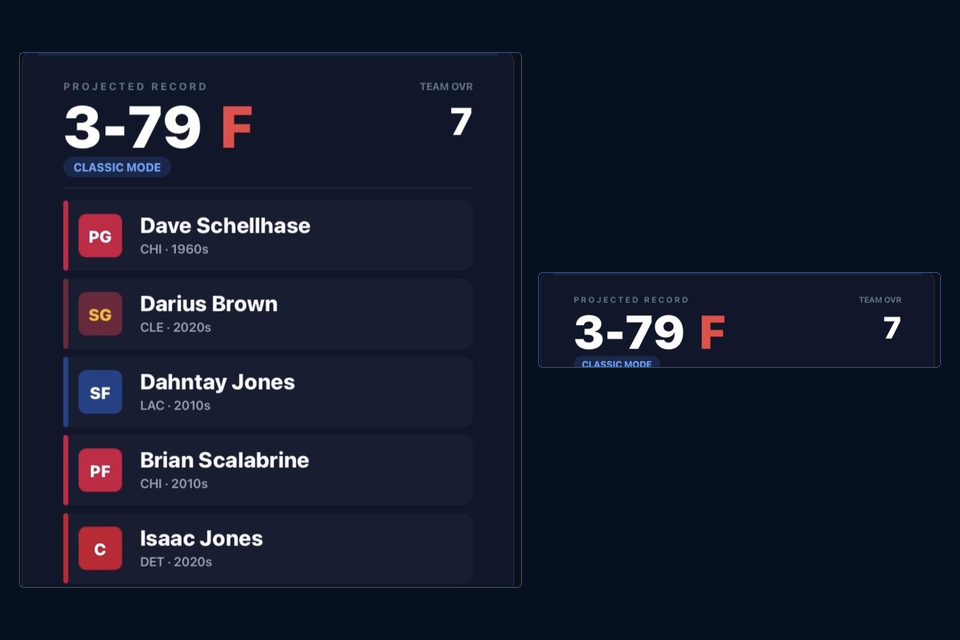
Make the attempt easy to reconstruct
- Information
- Mode and visible stat basis
- Draw
- TEAM and ERA for each selected card
- Placement
- The five final slots
- Actions
- Respin or special action actually used
- Decision
- One rejected legal alternative worth revisiting
- Finish
- Returned wins and losses
If a draw is awkward, give the available respin a specific purpose: replace the condition blocking a lower-output legal choice. The TEAM–ERA guide explains which condition each basic control preserves.
Keep a completed low-win attempt with its legal choices; the next draft gives you another comparison to inspect.
Play on the homepage →