Steals Per Game: Follow the Credit
A touch, a deflection and a possession-winning steal are different events. Use this 82-0 game casebook to read SPG without losing the credit rules or the decimals.
Who gets the steal?
A steal is about a defensive action that gains possession, not just a hand touching the ball. Open these three situations to follow the credit. They explain basketball events; they are not claims about a hidden possession simulation in 82-0.
Case 1 · A defender intercepts a pass
The defender reads the pass and takes possession. The interception supplies the steal credit. A pass can look risky without producing a steal if the offensive team keeps the ball.
Case 2 · One defender deflects, a teammate recovers
A controlled deflection causes the opponent to lose possession, and a teammate secures the ball. The defender responsible for the deflection can receive the steal. Credit does not automatically follow the person who finishes holding it.
Case 3 · The attacker retains the deflected ball
The defender disrupts the pass, but the attacking team recovers and continues. The touch alone does not supply a possession-winning steal. Disruption and credited takeaway are different observations.
An average leaves the sequence behind
Both fictional ten-appearance samples below contain ten steals. One has two five-steal games and eight zeros. The other has one steal in every appearance. Their average is identical; their distribution is not.
| Appearance | Burst sample | Even sample |
|---|---|---|
| 1 | 0 | 1 |
| 2 | 0 | 1 |
| 3 | 0 | 1 |
| 4 | 5 | 1 |
| 5 | 0 | 1 |
| 6 | 0 | 1 |
| 7 | 0 | 1 |
| 8 | 5 | 1 |
| 9 | 0 | 1 |
| 10 | 0 | 1 |
| Total | 10 | 10 |
| Total ÷ 10 | 1.0 SPG | 1.0 SPG |
The 82-0 game card gives you an average, not the sequence needed to distinguish these patterns. It would be a mistake to attach a consistency bonus or penalty to either pattern as though the game had displayed it.
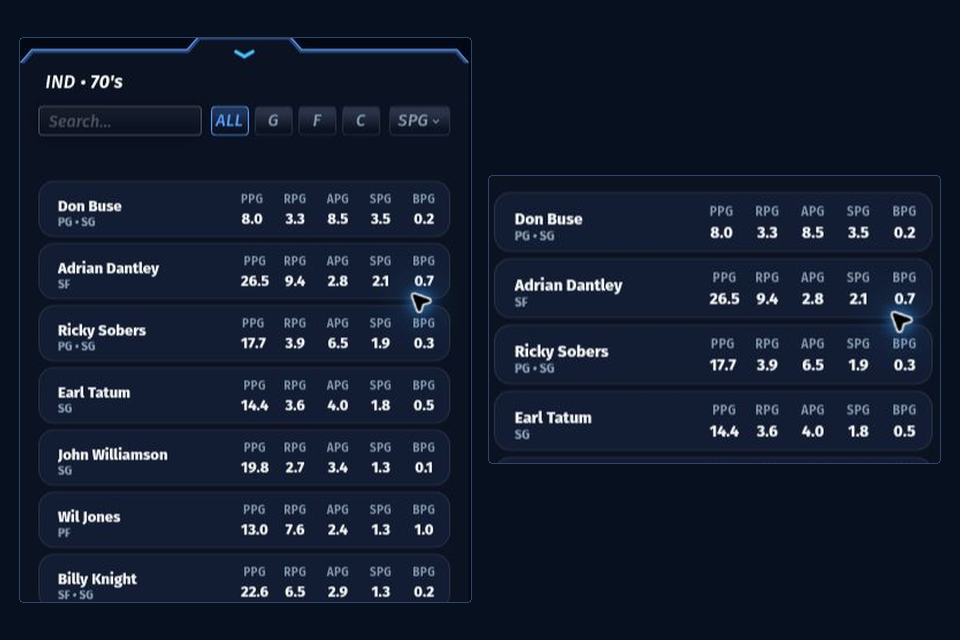
Do not turn half a steal into one
A displayed comparison of 1.2 versus 1.7 has a gap of 0.5 SPG. Round each to the nearest whole number and you get 1 versus 2: the apparent gap doubles to 1. Truncate both instead and you get 1 versus 1: the gap disappears.
Neither shortcut preserves the printed comparison. Copy the decimals first, then subtract within the category. The rounding workbench also explains why adding printed card numbers may differ slightly from a team total formed before display rounding.
Preserve the SPG decimal and explain the other changes in the same choice.
Play on the homepage →