Start with the card you can keep
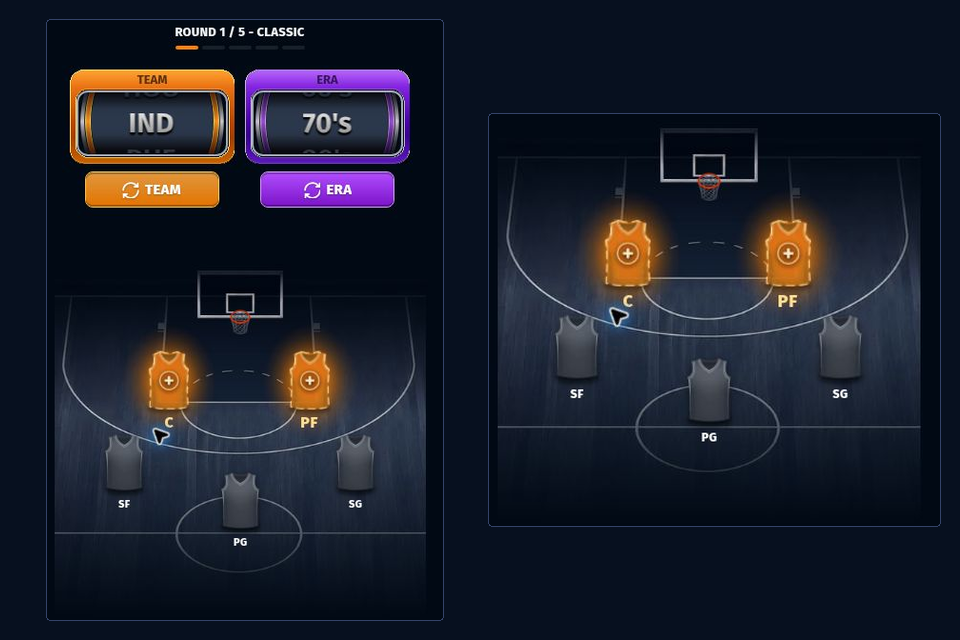
The first offer in the 82-0 game has an empty board to work with. Find the best card you can actually place, then decide whether to keep it or use a respin. You are comparing a known opening with another draw, not selecting the next four teammates in advance.
In Classic, inspect more than the column used to sort the list. In HoopIQ, connect the candidate to the drawn franchise and period. If the roll is unfamiliar, unfamiliarity alone is not evidence that its best card is weak. The memory workbook helps separate those two problems.
Before tapping a jersey, check the other highlighted destinations. A multi-position card may give you two ways to begin. Later legal moves can help, but every moved player still has to fit; flexibility is something to inspect, not permission to rearrange any five names.
The opening fork
Keep a card you can justify
Identify the actual candidate and its strongest contributions. Then ask what an alternative in the same pool gives up or gains. If the current choice survives that comparison and fits the board, you have a concrete reason to take it.
Keeping the offer preserves the displayed respin budgets for a later decision. That is an option you retain, not proof that saving every allowance will produce a better result.
Spend a respin for a clear reason
A respin gives you another unknown pool. Name what is unsatisfactory about this one before acting: the franchise, the period, or the usable options they produce together.
Check which part you want to preserve and which control can change the other. An opening skip is defensible when you understand the exchange; it is not automatically good because nothing has been placed yet.
Both branches continue the same five-pick draft. Neither describes a guaranteed route to 82 wins.
The first placement is also a slot choice
Suppose an illustrative opening card offers PG and SG. Placing it at PG keeps SG open; placing it at SG keeps PG open. The player is the same in this example, but the board presented to later candidates is different.
Now suppose the card went into PG, SG is still empty, and a later PG-only candidate appears. If the board offers a legal move from PG to SG, you can move the first card and open PG. Clear the active candidate selection before using the jersey move, then return to the new candidate.
The same move will not work if SG is occupied by a player who cannot move into PG, or if the first card lacks SG compatibility. Check the card labels and the board’s highlighted targets. This is why the placement matters even though some arrangements can be changed later.
Account for what a skip discards
| Write down | Why it matters | An unsupported shortcut |
|---|---|---|
| The best usable candidate you found | This is the known option a respin would replace. | “There must be someone better on the next roll.” |
| The part of the roll worth retaining | It identifies whether TEAM or ERA fits your concern. | “Both buttons solve the same problem.” |
| The available allowance and condition | The action may change what remains for later rounds. | “I can always skip again.” |
| The position you would occupy | Placement shapes the open spaces after the first selection. | “Positions can be sorted out after all five names.” |
Which half of the roll is the problem?
“I found a usable card and can defend its trade-offs.”
Keep it if that reasoning survives a look at the other options. There is no obligation to use a respin just because its control is available. Carry a clear placement forward and assess the next draw on its own terms.
“I like this era, but the franchise gives me little to choose.”
That is a TEAM question. Examine the franchise-exchange cases after checking that a filter is not hiding candidates you could use.
“I know this franchise, but this period is the concern.”
That is an ERA question. The period decision guide asks whether your reason concerns the actual pool or only the part of team history you remember best.
After you place the opener
After the opening placement, check the occupied jersey and the remaining spaces once. If you used a respin, remember the actual usable card you rejected. Those two observations are enough to revisit the opener if a later position gets awkward.
For another draw, assess the cards that actually arrive. Use a legal move when it fits, and use the repair guide if you notice that a filtered view or a rushed tap shaped the opener. A clear first decision is a starting point for the run, not a reason to ignore everything that follows.