Season Projection: Read the Result You Received
A strong summary and a strong record are related through the game’s conversion, not an equation printed on the cards. This 82-0 game guide shows what you can check after a finish.
Read a record as a record
This invented result has eighty-two games: seventy-six wins plus six losses. The bar below visualizes that count. It does not estimate what any particular lineup would produce.
The record is the output. Your roster's five category contributions are inputs to a different stage. Reading both stages keeps an impressive stat line from turning into an unsupported promise about wins.
Where the visible information ends
Game-specific conversion
The exact coefficients and winning thresholds are not established as a verified formula on this site.
The completed draft receives its result. The result presentation shows that returned record; its animation does not reveal the calculation that produced it.
The game's explanation describes a nonlinear projection, with stronger demands toward a perfect season. That gives useful direction, but not a calibrated curve. It cannot tell you that one extra RPG is worth a fixed number of wins, or locate an exact “perfect record” cutoff.
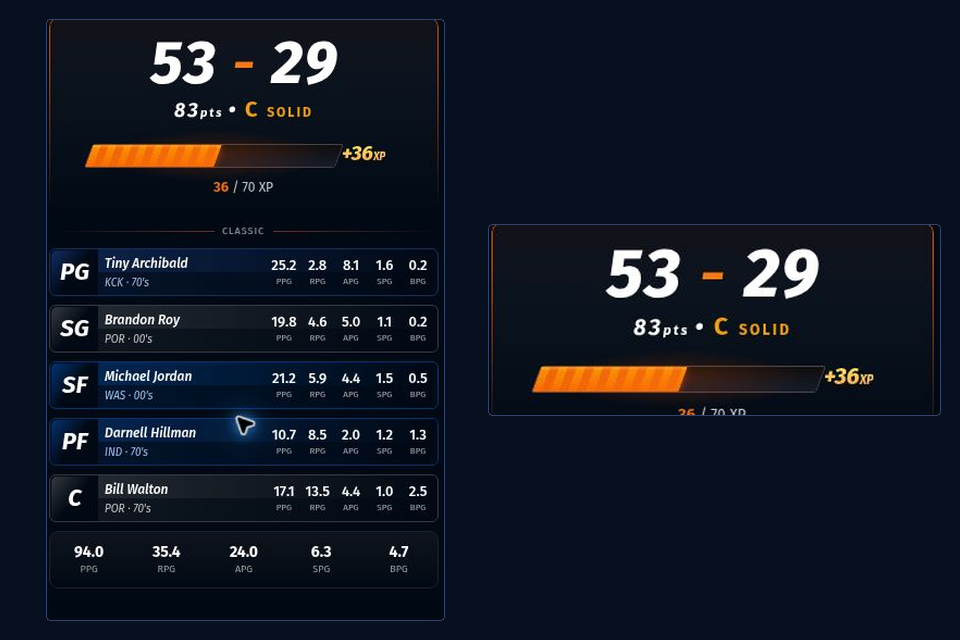
Three separate checks
- Record arithmetic
- Wins plus losses should describe the stated season length. This checks the record's presentation, not the quality of its statistical model.
- Contribution arithmetic
- Compare like categories. Team totals can be formed before display rounding, so printed card fields may not reproduce the last decimal exactly.
- Context identity
- Keep the franchise-era entries attached to the run. A same-name card from a different context is not necessarily the same statistical input.
What a comparison can support
| Observed | Supported description | Claim needing more evidence |
|---|---|---|
| One roster leads in a printed column | Its shown contribution is higher in that category | That lead guarantees more wins |
| Printed totals match | The summaries match at displayed precision | All supplied inputs or internal precision match |
| Two completed runs return the same record | Those runs share that output | Their inputs were equal, or every repeat must match |
| A roster returns a strong record | The game assigned that result to this completion | The same players would produce it in a real season |
A flat tradeoff deserves a flat description: you gained one category and gave up another. The card lab makes the exchange visible without turning it into an invented win calculator.
Keep your actual returned record with the exact entries that produced the attempt.
Play on the homepage →