Begin with the only open jersey
The last pick in the 82-0 game starts with four placed players and one empty jersey. Check candidates that fit that space, then inspect any legal move that could free another position. The present gap is your starting point, not always the only arrangement the board permits.
Use the full pool to make that check. If a placed PG/SG card occupies PG while SG is empty, for example, a permitted move into SG would free PG for a PG-only candidate. This is hypothetical eligibility; in your run, follow the positions and highlighted targets shown by the board.
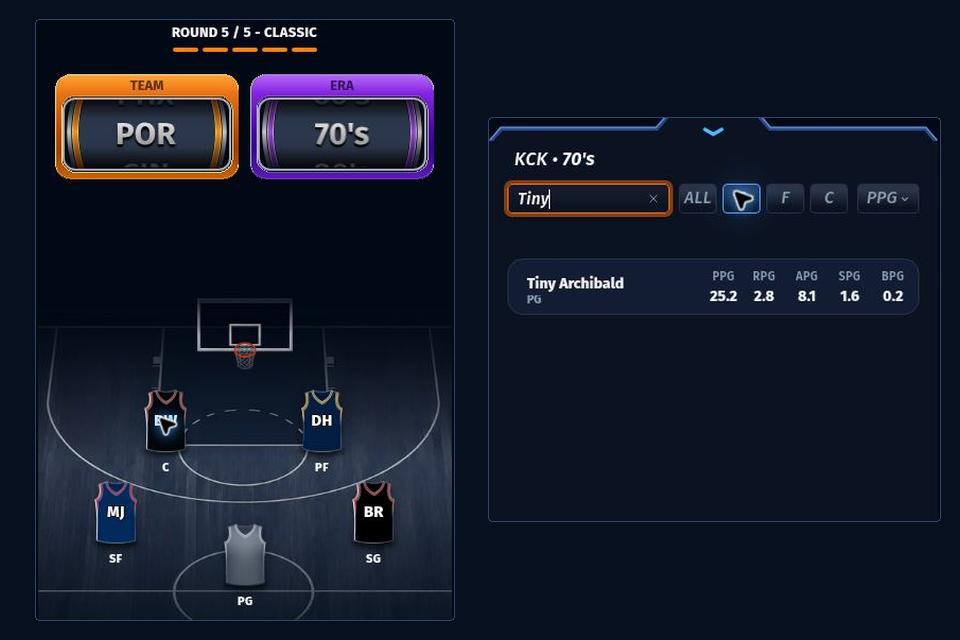
Bring your four-player notes into the last round
In Classic, record each selected card’s PPG, RPG, APG, SPG and BPG before placing it. At pick five, add those four recorded lines one column at a time. The placed jerseys identify the players; do not expect them to show the full five-stat line.
If you did not keep those notes, compare the final candidates’ visible columns now and inspect the completed roster details after the result. You can still make a useful last-card comparison without reconstructing numbers you did not record.
In HoopIQ, use the roles you remember rather than fabricating exact totals. You can still compare whether the last legal candidates are remembered mainly for scoring, creation or frontcourt production. The memory checks are useful when you realize one of those expectations is uncertain.
Add one practice card to four-player totals
This exercise uses wholly illustrative values. Both practice cards are assumed to fit the same remaining position. No number below is a real card value or an 82-0 season forecast.
| Illustrative contribution | PPG | RPG | APG | SPG | BPG |
|---|---|---|---|---|---|
| Four-player totals | 94 | 30 | 24 | 5 | 4 |
| Practice A adds | 18 | 3 | 9 | 1.5 | 0.2 |
| Practice B adds | 24 | 6 | 4 | 1 | 0.5 |
| Totals with A | 112 | 33 | 33 | 6.5 | 4.2 |
Within each category, the longer bar is scaled to the larger of the two possible totals. Bar lengths across different categories are not comparable. The exercise performs addition only.
Explain the exchange you are choosing
The practice pair has a genuine conflict. A contributes more assists and steals; B contributes more points, rebounds and blocks. Neither option exceeds the other in every column. The arithmetic exposes that exchange without selecting an automatic winner.
Apply the same habit to the actual legal options on your screen. State what changes in the roster totals if you choose the alternative. If one card is at least as productive in every counted category and better in one, that is a different comparison from the practice pair. Do not claim that a mixed exchange guarantees a specific win gain.
Keep the categories separate. PPG and BPG use very different scales, so the smaller-looking total is not automatically the more important gap. The exercise shows additions; the game supplies the projected record after you place the real fifth player.
A remaining respin is still an exchange
There is a usable fallback
Record it before replacing the draw. Its compatible slot and contribution are known; the next roll's answer to that final position is not. Check whether TEAM or ERA preserves the part of the offer you value.
The full pool offers no legal placement
Check the full pool, each candidate’s offered positions and any legal jersey rearrangement. If none creates a placement, inspect the available respin controls. An impressive but unusable card is not a fallback you can actually keep.
The TEAM cases address a franchise change; the ERA switchboard addresses a period change. Neither guide overrides the last jersey's compatibility requirement.
Keep the alternative with the returned result
Before placing the last player, note the best alternative and the categories it would change. That note survives a disappointing or exciting finish. A season record alone cannot reconstruct the comparison you faced.
Review whether your final choice respected the board and used the information available in your mode. If you forgot a filter or selected from memory of the wrong context, the fix is specific. Use the repair guide to change that habit on the next run, rather than rewriting every earlier pick after seeing the outcome.