Repair the cause you can observe
A draft mistake is easier to fix when you describe the action that caused it. “My team was bad” offers no next step. “I left a guard filter active while looking for a center” does. The five patterns below concern decisions and controls you can inspect during a run.
Pick the symptom closest to yours, then read its repair. A blank game frame or a connection failure is a different problem; use the loading help for those. This page is about avoidable selection habits, not treating every disappointing result as user error.
Five habits and their replacements
Choosing a reputation instead of this card
You recognize a name and stop inspecting the version. The remembered achievement may belong to another team, another period or one exceptional season. None of those establishes the output of the offered franchise-and-era entry.
Replace the habit: state the context first, then explain the contribution you expect. In Classic, verify that expectation against the visible columns. In HoopIQ, acknowledge the part of the context you cannot recall instead of filling it with the player's whole-career reputation.
There is a similar shortcut with a scoring sort: the first row becomes “best” without another column being read. The sorting exercise shows why a list leader is a category leader.
Calling a filtered list the entire pool
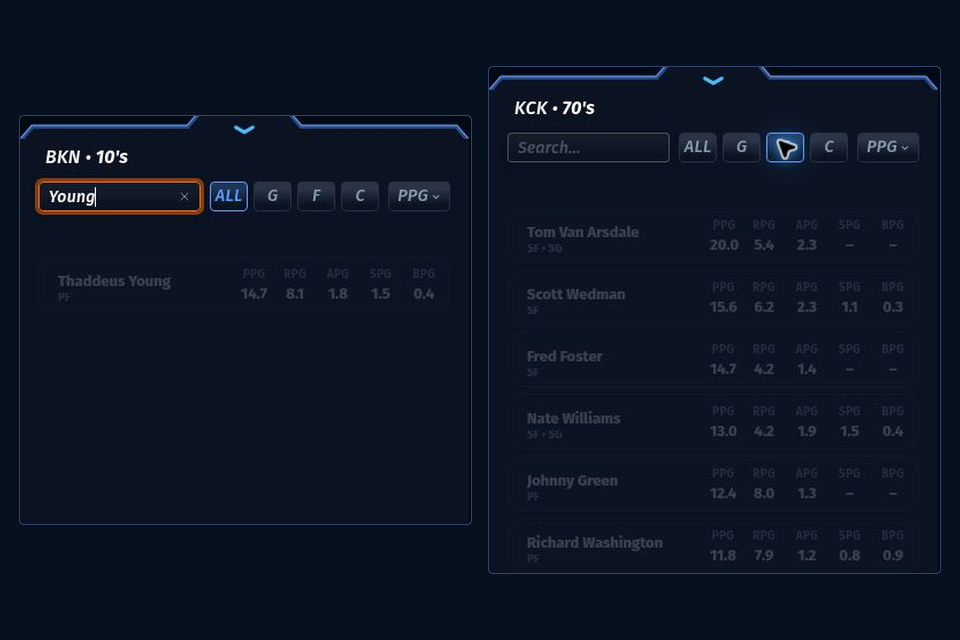
You apply a name search or G filter in the current pool and then judge that restricted view as the whole offer. The missing candidates may simply be outside the view you chose. A new draw resets the controls, so this repair concerns how you inspect one draw.
Replace the habit: clear the name field, choose ALL, and see what returns. Apply a role filter again only when it serves the position you need. An action that restores the view is not the same as an action that redraws the game.
Do this before spending TEAM or ERA. A respin would discard the original offer without showing whether its apparent weakness came from the filter. The walkthrough's recovery table places that check beside the step where the list stopped making sense.
Reading the candidate and ignoring placement
A candidate may not fit the empty jersey in the current arrangement. Before ruling it out, check whether a placed card can legally move and free a compatible space. A broad G or F label in the list is not enough to establish that move.
Replace the habit: read the candidate’s offered positions and the board’s highlighted targets. To rearrange, clear the candidate selection, select a movable filled jersey and choose a legal destination. Both players must fit when a move becomes a swap.
Use the opening placement example when several jerseys are available. Use the last-slot audit when the board has only one legal space left.
Spending a respin without naming the problem
You press the available control because the draw feels awkward. Only afterward do you realize that you wanted to keep the franchise, or that a legal fallback was better than the replacement.
Replace the habit: name what you want to retain, inspect the applicable counter and record the card you are rejecting. TEAM replaces the franchise; ERA replaces the window. The displayed conditions matter as well as the difference between the labels.
If you cannot explain the concern beyond a logo or a famous missing name, inspect the actual options again. The franchise cases and period framework show different evidence for an exchange.
Letting one result rewrite every decision
A high finish makes all the picks look smart; a low finish makes them look foolish. That skips the alternatives, available information and placement constraints you faced. It also ignores differences between draws and between modes.
Replace the habit: review a specific choice using the evidence that existed before it. Was the alternative usable? Had you inspected it? Did the selection do what you intended? The returned record is part of the attempt, not a complete explanation of its reasoning.
Keep the mode and lineup with the record. If you change several habits on the next run, do not credit its result to a single one without further evidence. Pick a manageable practice question from the strategy directory.
A better three-part review
Before
Keep the drawn context, usable alternative and remaining spaces.
During
Note the actual action: filter, selection, placement or respin.
After
Read the returned outcome without inventing the cause.
Keep the offer, the action and the outcome as separate parts of the same attempt.
A useful note can be brief: “I filtered to guards, searched one name and pressed TEAM before checking ALL.” It identifies an action you can repair. On the next draw, restore the whole view before making that same decision.
Choose one replacement habit for the next attempt
| If this is your habit | Practice this observable action |
|---|---|
| Choosing from reputation | Describe the offered version before naming its strength. |
| Skipping a narrow-looking list | Restore an unfiltered view before judging it. |
| Rushing placement | Read every offered open jersey before choosing. |
| Pressing either respin by feel | Say which half of the draw you want to retain. |
| Explaining everything through the record | Preserve one alternative and your reason before committing. |
For your next 82-0 game attempt, choose one row and perform its check before the pick. If it catches a mistake, keep that habit; if the check was already reliable, move to another row. The point is to change an action you can see, not explain every loss after it happens.