Let a legal wing carry more points
A center does not have to lead your scoring column. Compare the points available at the other open positions before making C responsible for the whole offense.
Playing the 82-0 game without Wilt? Define the restriction first, then work out which contributions the available cards can share. A replacement name is only part of the decision.
“Without Wilt” can mean two things: he never appears in your offers, or you turn down every Wilt Chamberlain entry on purpose. Pick the rule you mean. Otherwise a good run can become a different challenge halfway through, and you will have no clear answer to what you completed.
The ordinary roster still has five places. Excluding a name does not create an extra jersey or change the placement rules. You are testing how well you use the offered cards when a familiar source of frontcourt production is absent.
Do not start with “Who is the next Wilt?” Start with the contribution you were hoping to obtain. Was it a large PPG line, rebounds, or both? Those jobs can be divided among players. Trying to find a single substitute who matches a remembered peak gives every other center an impossible audition.
A center does not have to lead your scoring column. Compare the points available at the other open positions before making C responsible for the whole offense.
Extra RPG from a forward can reduce the job left for the center. That arithmetic is more useful than judging the replacement by name recognition.
The offered center may bring blocks or passing that your imagined replacement lacked. Inspect its full line instead of treating every difference from Wilt as a loss.
This is a way to organize a draft, not a claim that basketball roles receive hidden bonuses. The five-category atlas explains the inputs; the board decides where each offered entry can go.
Here is a fictional five-card contribution sheet. These are practice values, not actual NBA cards or a lineup recipe. Each entry is assumed to fit the listed slot. The sheet asks a narrow question: does all the scoring and rebounding have to come from the center?
| Slot | PPG | RPG | APG | SPG | BPG |
|---|---|---|---|---|---|
| PG | 23 | 4 | 10 | 1.7 | 0.3 |
| SG | 27 | 5 | 5 | 1.6 | 0.5 |
| SF | 24 | 8 | 6 | 1.5 | 0.8 |
| PF | 20 | 11 | 3 | 1.1 | 1.7 |
| C | 18 | 13 | 2 | 0.8 | 2.4 |
| Exercise sum | 112 | 41 | 26 | 6.7 | 5.7 |
For a real Classic run, printed decimals can conceal rounding. Your notes are a comparison aid, not a promise to reproduce the result screen exactly. The averages workbench explains that display detail.
Compare its legal alternatives. If it supplies the contributions you can use, the restriction is already working: you are judging the entry rather than chasing the star.
Check the complete candidate view and any legal rearrangement before narrowing the pool to your mental list of centers. Use the board's positions, not a player's remembered role.
Name the loss before changing the draw. A remaining TEAM or ERA respin replaces part of the offer; it does not reserve a preferred replacement for you.
The TEAM guide and ERA guide own the full respin decisions. For this challenge, the important distinction is between an unusable offer and an offer you dislike because it is not Wilt.
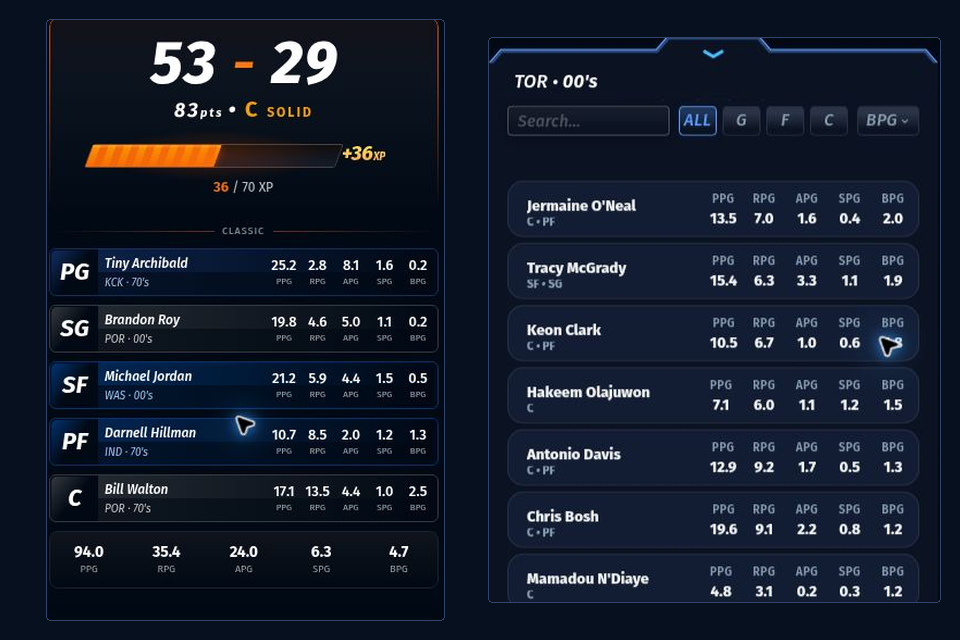
Try the restriction with a plan for contributions rather than a replacement name.
Play on the homepage →