Players · Volume case study
Wilt Chamberlain: Two Big Columns to Read First
Wilt draws attention fast in the 82-0 game. Look at scoring and rebounds together, then ask which version of his career the draft has put in front of you.
The volume reputation has two parts
Those are Wilt's completed regular-season career averages, rounded to one decimal. They explain why fans look for both scoring and rebounding when his name appears. They cover his whole career, rather than one franchise-era card.
In a draft, turn that recognition into two questions: how much scoring does this Wilt add over the other usable center, and how much rebounding does he add? Keeping the questions separate catches a choice that looks obvious in one column and much closer in the other.
Philadelphia is not one franchise chapter
Wilt played for the Philadelphia Warriors, followed that franchise to San Francisco, later joined the Philadelphia 76ers, and finished with the Los Angeles Lakers. Two of those jerseys say Philadelphia, but they belong to different franchise histories.
- WarriorsPhiladelphia and San Francisco are chapters of the franchise that later became Golden State.
- 76ersThe Philadelphia city label does not make this a Warriors version.
- LakersThe later chapter has its own period and statistical sample.
Keep the team label beside the number when recording a Wilt choice. The pool membership guide explains how that franchise connection meets the period in the draw.

Philadelphia Warriors versus New York100Historical single-game points
How the hundred was scored
| Source | Made / attempted | Points |
|---|---|---|
| Field goals | 36 / 63 | 72 |
| Free throws | 28 / 32 | 28 |
| Combined | Different attempt types | 100 |
Floor · 72Line · 28
The arithmetic is 36 × 2 + 28 = 100. The photograph of Wilt holding “100” captures the event beautifully, but the event answers a single-game question. A PPG field answers an average-production question.
Work outward from PPG and RPG
Both columns lead
Read the remaining three fields before calling the comparison settled. A center who loses volume may still supply more creation or another defensive contribution.
Only scoring leads
The rebound difference is part of the price. Say how much the alternative adds on the boards instead of describing Wilt's advantage as a single overall number.
Only rebounds lead
Do the reverse: keep the boards advantage visible while describing the scoring you surrender. The huge remembered scoring night should not conceal this card's exchange.
Older defensive statistics may involve estimates, so read their context carefully. The block-data guide handles that shared issue; the center comparison still includes all five fields the game supplies.
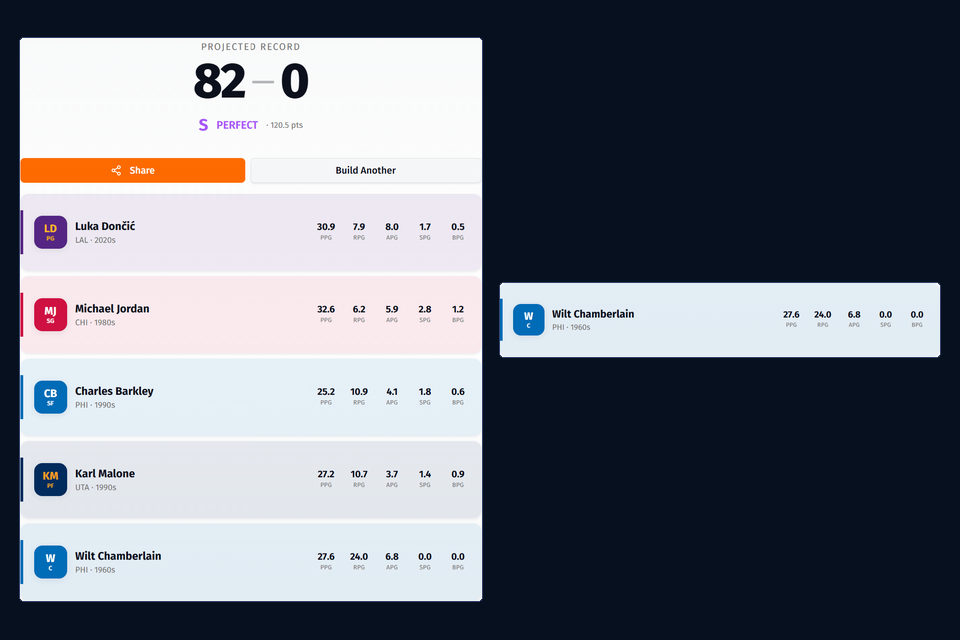
When Wilt appears, write down the PPG and RPG exchange before the name makes the decision for you.
Play on the homepage →