Scoring
How much does PPG change against the other legal center? The skyhook is a useful image of the scorer, but the card supplies the size of the gain.
The skyhook makes Kareem easy to recognize. The 82-0 game decision still asks three separate frontcourt questions: how much scoring, how many rebounds, and what blocks are shown?
How much does PPG change against the other legal center? The skyhook is a useful image of the scorer, but the card supplies the size of the gain.
Do you keep the RPG contribution with that scoring choice? More points can come with fewer boards; describe both sides of the center exchange.
What BPG is shown, and which career period does it describe? The earliest record coverage makes this question especially important for Kareem.
Then include APG and SPG. The three frontcourt questions focus your attention; they do not remove the other two fields from the game. A complete comparison still reads the entire line.
Kareem recorded 40 points, 15 rebounds and four blocks in that Game 5. The single-game line makes the three frontcourt contributions concrete; it is not an average for a draft card.
Keep the units attached. Forty points and four blocks are different event counts, not numbers on a shared rating scale. For the draft version, ask which of the three categories leads against the alternative rather than looking for a single “center score.”
Kareem began his NBA career before official block tracking. His first four seasons fall before that record begins. The absence says that those blocks were not measured in the official series; it does not say he blocked zero shots.
| Observation | What you can conclude | What remains unresolved |
|---|---|---|
| No early official blocks | A gap in measurement | The actual missing block count |
| The game supplies an early BPG value | A usable field in that game version | Its estimation method, unless separately established |
| The card says Milwaukee | A franchise connection | The exact sample and its block-record coverage |
Use the block-data guide for the general distinction between a value, a dash and an estimate. Here the practical point is specific: the franchise badge alone cannot settle the early-Kareem coverage question.

A period-wide value can look modest beside a famous night and still be useful in the current choice. The sample explanation helps you distinguish that broader average from a peak.
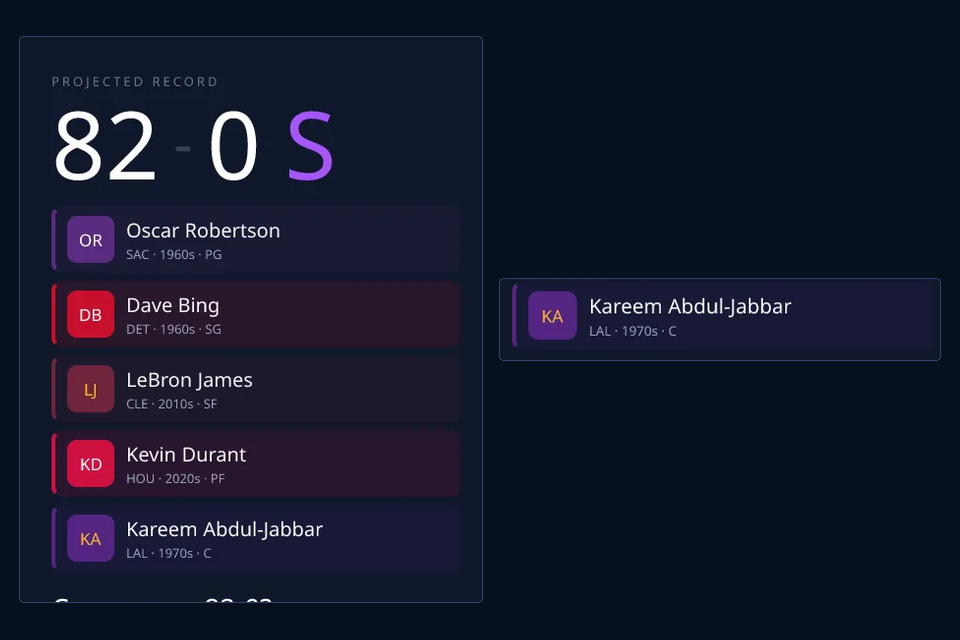
This completed share card places Kareem at C for Los Angeles in the 1970s. It identifies the entry without displaying numeric averages; use the matching Classic candidate card for the statistical comparison.
Compare the centers one job at a time, keeping the block-data coverage attached to the numbers.
Play on the homepage →